
2025 has passed months ago. I have not taken the time to evaluate the performance of my energy consumption goals.
The situation also didn’t change that much compared to previous year.
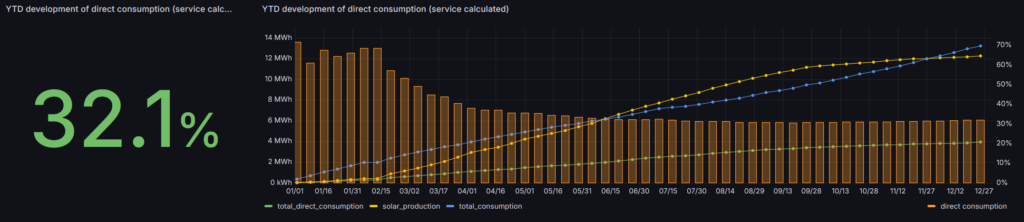
I closed the year with a direct consumption of 32.1%. This is very close to the 34.1% of 2024. I’m far away from my goal of 45%. Unfortunately this looks like this is the best I can do based on my current technical set-up and consumption patterns.
Let’ have a look at the car charging and heatpump planning numbers.
Car charging
This is where things went “wrong”. In total the car consumed 6400kWh in 2025, which is more or less the same as 2024. 1171kWh was produced by solar energy, compared to 1730kWh (26.1%) in 2024.
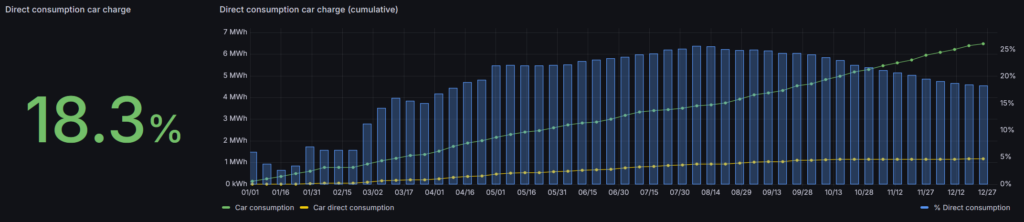
We are using the car during the day and therefore need to charge it during the night. There is little more to improve here, other than postponing the charge as much as possible when we know we don’t have to use the car the next day.
Heatpump planning
Finally some good news! In total the heatpump consumed 2724kWh (2596 degree days) over 2025 (compared to 2650kWh in 2024, 2426 degree days). The direct consumption went up from 27.9% in 2024 to 37.4% in 2025.
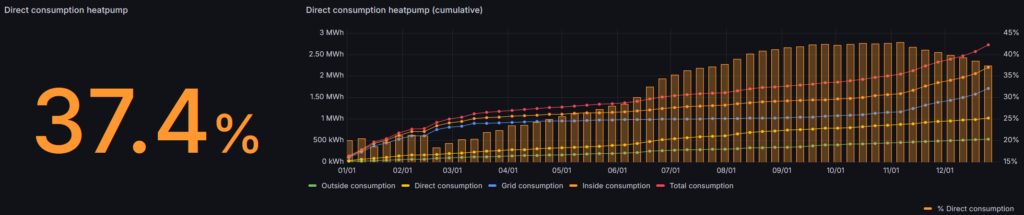
The algorithm changes in the last part of 2025 seem to have worked over 2026. I’m curious to see how this will develop over to 2027.
Overview
I need to look into the 8% drop of direct consumption by the car, and the limited impact on the total direct consumption (even though the car is contributing to roughly 50% of our entire consumption).
| Year | Direct Consumption | Car | Heatpump |
| 2023 | 19% | n.a. | n.a. |
| 2024 | 34% | 26% | 28% |
| 2025 | 32% | 18% | 37% |
Looking forward
I’ve kept an eye on these number during 2025 and already concluded I’ve reached the limits of the current way of working. I started to consider purchasing a home battery in October. I was hoping to find a 3-phase system that would be able to flexibly deliver energy on all three phases. I couldn’t find a system what would be able to do this. My next chain of thought was to purchase three 1-phase systems, but that would mean an investment of over 10.000 EUR on technology of which I don’t know if it helps me to achieve my goals and how long it will last.
Eventually, I decided to purchase one 1-phase system with roughly 9kWh of capacity: the Zendure AC2400 with three batteries.
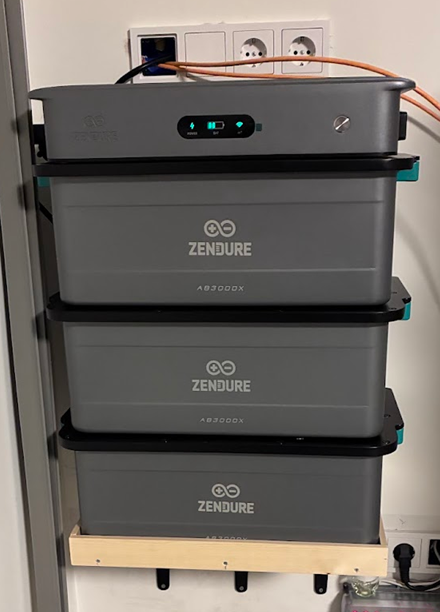
They had a good end of the year deal and after some fiddling around with their API I managed to integrate the system into the digital twin of my house. As it’s a 1-phase system I’m just looking at the total consumption and delivery of the 3-phases. The battery charging strategy works based on the EPEX energy price and the predicted amount of solar energy for the upcoming day. If the amount of solar energy is large enough, it waits until the peak moment of the day and then starts charging at full speed. When the difference between the highest and lowest energy price meets a certain threshold, it charges at full speed during the lowest point. Last, when predictions are bad, it just prevents energy from being delivered back to the grid.
For now this is working, but I’m sure I will need the rest of 2026 to optimize the charging and discharging strategy. I am already seeing an impact on my energy dependency but I still need to analyze the data and think of a good KPI to monitor the progress.